Roam Glade Editorial · Updated November 2026
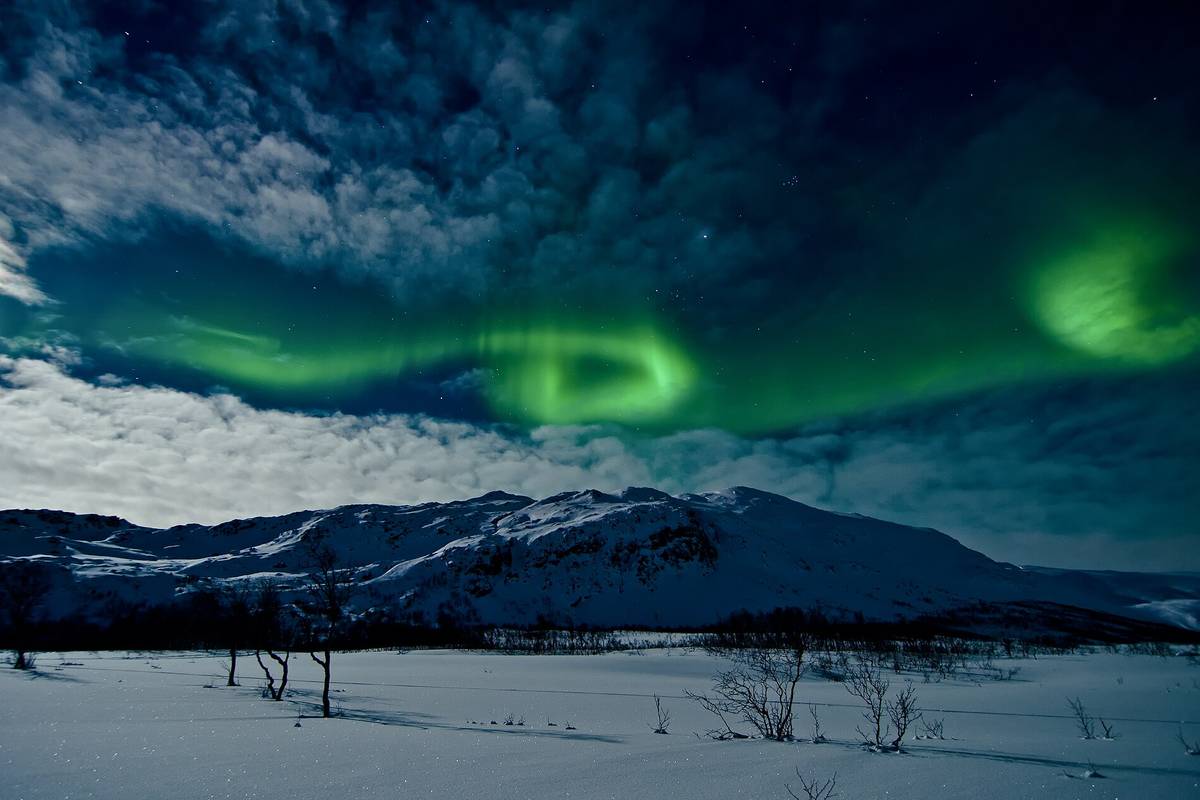
The northern lights (aurora borealis) appear when charged particles from the sun hit the upper atmosphere. They are strongest in a ring around the magnetic north pole called the auroral oval, which crosses northern Norway, Sweden, Finland, Iceland, northern Canada and Alaska.
To see them you need three things at once: darkness, clear skies and enough solar activity. Get the first two right and the third often follows.
Seven Places to See the Northern Lights
Tromsø and Northern Norway
September–MarchWell inside the auroral oval, with a mild coastal climate for the latitude. Tours drive inland to find clear skies, which helps when the coast is cloudy.
Abisko, Swedish Lapland
September–MarchKnown for a rain shadow that often keeps the sky clearer than nearby areas. Reachable by train from Kiruna and Stockholm.
Finnish Lapland
September–MarchRovaniemi, Saariselkä and Inari offer glass igloos and cabins designed for aurora viewing, plus husky and reindeer activities in winter.
Iceland
September–mid-AprilEasy to combine with waterfalls and hot springs; you can see the aurora away from Reykjavík's lights, for example near Thingvellir or on the South Coast. Weather is changeable, so stay flexible.
Yellowknife and Yukon, Canada
Late August–AprilYellowknife sits under the auroral oval with cold, dry, often clear winter nights. Whitehorse in Yukon is another good base.
Fairbanks, Alaska
Late August–AprilUnder the auroral oval, with lodges and hot springs outside town. Very cold in midwinter.
Northern Scotland
September–MarchPossible on strong nights from Caithness, Orkney, Shetland and dark-sky areas such as the Cairngorms. Less reliable than the Arctic, but a bonus on a winter Highland trip.
When to Go
In the northern hemisphere the season runs from about late August or September to March or April. From May to July the midnight sun means it never gets dark enough in the Arctic.
The sun's activity follows an 11-year cycle. Solar Cycle 25 reached its maximum around 2024–2025, and strong displays are often still frequent in the years just after a peak. Within any season, nights around the new moon are darker, and the weeks around the September and March equinoxes often bring more activity.
How to Improve Your Chances
- Stay several nights. Three to five nights in the Arctic gives you a much better chance of a clear night.
- Watch the forecasts. Check a cloud forecast first, then the aurora forecast (the Kp index and solar-wind data from NOAA's Space Weather Prediction Center or a local service such as the Icelandic Met Office).
- Get away from lights. Even a small town's glow washes out a faint display.
- Be patient and look north. Activity often comes in bursts, typically between about 9pm and 2am.
- Dress for standing still: thermal layers, insulated boots, hat and gloves. Or choose a glass-roofed cabin and watch from bed.
The Southern Lights
The aurora australis can be seen from Tasmania, southern New Zealand (including the dark-sky reserve around Lake Tekapo and Aoraki/Mount Cook) and Antarctica, mainly from March to September. See our South Island nature stays.
Questions People Ask
Where is the best place to see the northern lights?
Places under the auroral oval with dark skies and a good chance of clear weather: Tromsø and the Lofoten area in Norway, Abisko in Sweden, Finnish Lapland (Rovaniemi, Inari, Saariselkä), Iceland, Yellowknife in Canada's Northwest Territories, Whitehorse in Yukon and Fairbanks in Alaska.
What month is best for the northern lights?
September to March in the northern hemisphere. Many people aim for late September–October or February–March: nights are long enough, temperatures are less extreme than midwinter, and the weeks around the equinoxes often bring more geomagnetic activity.
Can you see the northern lights in Scotland?
Yes, on nights of strong activity, especially in the north: Caithness, Sutherland, Orkney, Shetland and the Cairngorms Dark Sky Park. Look north from a dark spot away from town lights.
Is a sighting guaranteed?
No. You need dark, clear skies and enough solar activity at the same time. Staying at least three or four nights in the Arctic improves your chances a lot.
Sources: NOAA Space Weather Prediction Center — aurora forecast; Icelandic Met Office — aurora forecast. See the full nature calendar for what else is happening each month.